
The Assertiveness Blueprint
An ACT-Based Guide to Setting Boundaries, Stopping People-Pleasing, and Saying “No” Without Guilt
Stop saying yes when your entire body is screaming no.


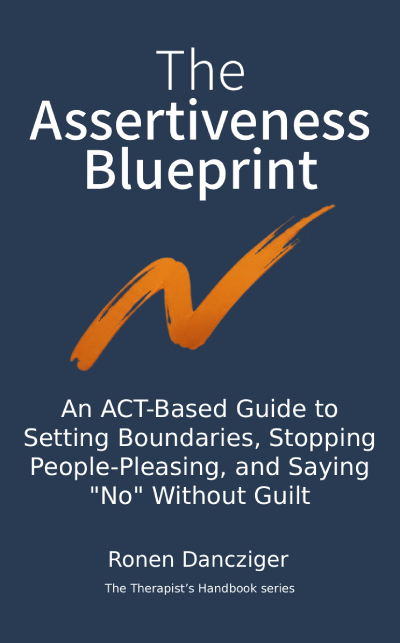
The Assertiveness Blueprint:
An ACT-Based Guide to Setting Boundaries, Stopping People-Pleasing, and Saying “No” Without Guilt
Real assertiveness has less to do with finding the right words and more to do with creating enough space to choose what you do next.
This book shows you how to communicate clearly, tolerate the discomfort that comes with setting boundaries, and hold your ground when the other person pushes back.
- ASIN : B0GVRYPVHR
- Publisher : Independently published
- Publication date : April 1, 2026
- Language : English
- Print length : 159 pages
- ISBN-13 : 979-8254575177
- Item Weight : 7.8 ounces
- Dimensions : 6 x 0.36 x 9 inches
Real Assertiveness Starts with Choice
“Real assertiveness has less to do with finding the right words and more to do with creating enough space to choose what you do next.”
Tired of saying “yes” when your whole body is screaming “no”?
When you spend your life agreeing to events, tasks, and demands that drain you just to keep the peace, you pay a quiet, compounding tax. The result isn’t just exhaustion. It’s burnout, hidden resentment, and the gradual loss of your authentic voice.
The Assertiveness Blueprint provides a practical framework grounded in Acceptance and Commitment Therapy (ACT), emotional regulation, and real-world communication tools. It helps you move from automatic compliance to steady, courage-driven, values-aligned communication.
Why Communication Fails: When Pressure Gets in the Way of What You Already Know
Most books on assertiveness sell you rehearsed scripts or persuasion tactics. But in the heat of the moment, when a manager demands a late-night deadline or a family member triggers a wave of guilt, rehearsed scripts can evaporate. Your chest tightens, pressure rises, and it becomes harder to access the communication skills you already know.
The Assertiveness Blueprint bridges external communication techniques with internal emotional regulation. When you learn to carry discomfort, such as guilt or anxiety, without letting it control your behavior, your words become clearer, steadier, and easier to deliver under pressure.
What Makes This Book Different? The NeuroFlex ACT Framework
Body, Mind & Speech Integration
A practical blend of ACT principles and regulation tools to notice and respond to internal alarm signals in real time.
Fluff-Stripping Refusals
Master the anatomy of a “clean no”: short, clear, steady, and free of defensive padding or excuses that invite bargaining.
Soft Disagreement Models
Five practical templates for expressing a firm counter-perspective without unnecessarily escalating defensiveness.
Neurodivergent Adaptations
Practical NeuroFlex ACT Notes throughout the book, with adaptations that may be especially useful for readers with ADHD, sensory overwhelm, or other neurodivergent experiences.
Interactive Worksheets & Practical Exercises
Includes self-assessments, practical exercises, and real-world script-editing workshops.
Table of Contents
Part I: The Internal Engine – Mastering Emotional Barriers
Chapter 1: Why Is Saying “No” So Hard?
Chapter 2: Unhooking from the Inner Dictator (Cognitive Defusion)
Chapter 3: Creating Inner Space with the Observer Self and Breath Anchors (Mindfulness)
Chapter 4: Embracing Discomfort: Clean Pain vs. Dirty Suffering (Experiential Acceptance & The Feel and Act Rule)
Part II: The External Toolkit – Communication, Digital Boundaries, and Pushback
Chapter 5: The Anatomy of a Clean “No” and Stripping Defensive Fluff
Chapter 6: Mastering Soft Disagreement
Chapter 7: Digital Boundaries: Managing Messages, Emails, and Read Receipts
Chapter 8: Handling Pushback Like a Professional: Broken Record, Fogging, and High-Pressure Response Tools
Chapter 9: Unmasking Manipulation and Unfair Dynamics (Reflection and Exposure Techniques)
Part III: Real-World Scenarios – Putting the Blueprint into Action
Chapter 10: The Professional Arena: Workplace Boundaries, Scope Creep, and Managing Up
Chapter 11: Family Dynamics and Intimate Relationships: Breaking Guilt Loops and Fostering True Intimacy
Chapter 12: Social Circles and Daily Interactions: Overcoming Social Obligation Guilt
Part IV: The Boundaries of Boundaries – When Assertiveness Isn’t Enough
Chapter 13: When Assertiveness Is Unsafe or Ineffective: Risk Assessment, Power Dynamics, and Safety Planning
Part V: Integration, Relapse Recovery, and Lifelong Practice
Chapter 14: Recovering from Slips (The Post-Slip Protocol)
Chapter 15: Cultural Calibration: Navigating Direct vs. Indirect Communication Cultures
Chapter 16: The 30-Day Implementation Action Plan & Habit Tracker Includes Special Appendix: The Assertiveness Cheat Sheet, a quick-reference guide for real-time application.
Who Is This Book For?
People-Pleasers
Anyone tired of feeling obligated to satisfy every demand at the expense of their own well-being.
Professionals & Managers
Leaders and professionals seeking to protect their capacity, manage scope creep, and set healthy boundaries in high-demand work environments.
Therapists, Coaches & Practitioners
Professionals looking for a structured, ACT-consistent framework and practical worksheets for client work.
Individuals Seeking Authentic Relationships
Anyone who recognizes that compliance is not intimacy, and that clear boundaries are essential for genuine connection.
Take Back Your Time, Energy, and Voice
“Real assertiveness has less to do with finding the right words and more to do with creating enough space to choose what you do next.”
Frequently Asked Questions
1. What is The Assertiveness Blueprint about?
The Assertiveness Blueprint is a practical, science-backed guide to setting firm boundaries, stopping chronic people-pleasing, and saying “no” without guilt. Unlike traditional manuals that focus solely on memorizing communication scripts, this book grounds assertiveness in Acceptance and Commitment Therapy (ACT), emotional regulation, and somatic awareness. It teaches you how to create the internal space needed to respond thoughtfully rather than reacting out of automatic compliance.
2. Why do traditional assertiveness scripts often fail in real life?
Most assertiveness books sell rehearsed scripts or persuasion tactics. However, when pressure mounts in high-stakes situations—like a manager demanding a late-night deadline or a relative invoking guilt—rehearsed scripts evaporate because your nervous system registers a threat. Communication doesn’t break down in the mouth; it breaks down in the nervous system. The Assertiveness Blueprint bridges external speech with internal emotional regulation, helping you carry emotional discomfort (like guilt or anxiety) without letting it control your actions.
3. What is the NeuroFlex ACT framework used in the book?
Developed by Ronen Dancziger, NeuroFlex ACT translates psychological flexibility into actionable behavioral tools. The framework integrates:
-
Body, Mind & Speech Integration: Tools to identify biological “smoke detectors” and somatic markers in real time.
-
Fluff-Stripping Refusals: Techniques to eliminate excessive apologies, false excuses, and defensive padding.
-
Soft Disagreement Models: Structural templates to express firm counter-perspectives without triggering defensiveness.
-
Neurodivergent Adaptations: Specialized notes offering tailored strategies for readers with ADHD, sensory overwhelm, or executive function friction.
4. What is a “Clean No” and what is “Fluff”?
“Fluff” consists of excessive apologies, false excuses, and defensive padding that people-pleasers add to refusals to soften the blow. Unfortunately, fluff signals to others that your boundary is negotiable and invites counter-offers. A “Clean No” is short, steady, direct (under ten words), and completely free of defensive padding or excuses.
5. What are the 5 models of “Soft Disagreement”?
Soft Disagreement provides structural shapes to express an opposing perspective without escalating conflict or triggering emotional armor:
-
The Perspective Shift: Widening the lens around a shared objective.
-
The Empathic Bridge: Validating operational pressure without absorbing the fallout.
-
The Open Door: Combining a firm wall with a constructive path forward.
-
The Direct Reframing: Stripping emotional packaging out of manufactured urgency.
-
The Partial Agreement: Conceding what is genuinely true before planting your flag on the rest.
6. Does the book include adaptations for neurodivergent individuals?
Yes. The Assertiveness Blueprint features dedicated NeuroFlex ACT Notes throughout the book. These provide concrete adaptations for readers experiencing ADHD, sensory hypersensitivity, time blindness, or executive function friction. Rather than relying on abstract mindfulness or real-time social improvisation, the book offers tactile anchors, pre-scripted low-word templates, and structured operational rules to protect cognitive energy.
7. Who is this book written for?
-
Chronic People-Pleasers: Individuals tired of sacrificing their time, rest, and energy to appease others.
-
Professionals & Managers: Leaders looking to set workplace limits, prevent scope creep, and manage high-pressure environments sustainably.
-
Therapists, Coaches & Practitioners: Professionals seeking a structured, ACT-consistent framework and client-ready worksheets.
-
Anyone Seeking Authentic Relationships: People who recognize that compliance is not intimacy and that boundaries are essential for genuine connection.
8. What practical worksheets and exercises are included?
The book functions as an active workbook containing:
-
Assessments: The Personal People-Pleasing Index and Values Clarification Drill.
-
Regulation Tools: The 30-Second Breath Anchor and Somatic Marker Mapping.
-
Communication Exercises: The Fluff-Stripping Drill, Pushback Simulation, and Emotional Mirror Scripting.
-
Safety & Risk Planning: A Safety Audit & Risk Checklist (Chapter 13) for high-risk or asymmetrical dynamics.
-
Action & Recovery: The Post-Slip Recovery Protocol, a 30-Day Implementation Habit Tracker, and The Assertiveness Cheat Sheet pocket reference.
9. Who is the author, Ronen Dancziger?
Ronen Dancziger is a therapist who works with CBT and ACT, a behavioral strategist, and the creator of the NeuroFlex ACT framework. Drawing on more than a decade of experience working therapeutically with individuals and groups, as well as years spent in the high-tech industry leading teams and navigating high-pressure environments, Ronen brings a practical, reality-based perspective to psychological flexibility. His approach focuses on translating complex psychological concepts into clear, actionable tools that can be applied in everyday life. He is also the author of The Therapist’s Handbook series, The Elastic Advantage, and The Boxmaker’s Apprentice.
10. What format is the book and where can I buy it?
The Assertiveness Blueprint is published independently (179 pages, ISBN: 979-8254575177) and is available on Amazon in print and digital formats.

Meet Ronen Dancziger
Ronen Dancziger is a behavioral strategist and the creator of The Elastic Advantage framework, a practical system designed to help high achievers maintain psychological range and operational velocity under extreme pressure.
With over a decade of experience as a Cognitive Behavioral Therapist specializing in Acceptance and Commitment Therapy (ACT), Ronen treats psychological flexibility not as a soft skill, but as the ultimate performance multiplier in today’s rigid and unpredictable world.
Before fully dedicating himself to behavioral strategy, Ronen spent years in the high-tech industry. He rose through senior management roles and eventually founded and led his own software company as CEO. That frontline experience taught him firsthand how quickly success can harden into rigidity and how fast a “seized transmission” can destroy momentum.
The question that drives his work today was born early. At the age of eleven, Ronen watched his father, a Holocaust survivor and legendary Israeli commando, suffer the first of several strokes. In a single night, the carefree boy became the “easy child” who performed to create safety. That moment planted a lifelong question: How do you build real strength without losing your elasticity?
A former powerlifter and certified Commando Krav Maga (CKM) Instructor, Ronen brings the raw mechanics of physical load, resilience under pressure, and reality-based performance into all his work.
He is also the author of the philosophical fable The Boxmaker’s Apprentice and the Therapist’s Handbook series. Through his global practice and the Feeling Good project, he makes powerful behavioral tools accessible without diluting their edge.
Ronen lives by one core operating principle: The terrain is unpredictable – your transmission shouldn’t be.

Subscribe & Get Your Free Copy of The Mini-Handbook for Time Travelers!
Struggling with regrets about the past or worries about the future? You’re not alone, and there’s a way forward. Join our newsletter today and receive your FREE copy of The Therapist’s Mini-Handbook for Time Travelers, a practical guide packed with powerful, no-nonsense strategies to help you navigate life’s toughest challenges. As a subscriber, you’ll also get:
- Exclusive NeuroFlex ACT insights you won’t find anywhere else
- Practical tools & exercises to build resilience and clarity
- Expert tips to stop coping and start thriving
📩 Sign up now and get your free handbook delivered instantly to your inbox!